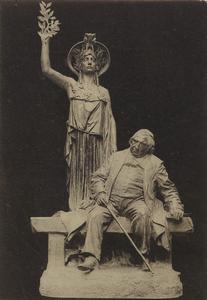


by Ernest Renan
Strangely enough, it was at Athens, in 1865, that I first felt a strong backward impulse, the effect being that of a fresh and bracing breeze coming from afar. The impression which Athens made upon me was the strongest which I have ever felt. There is one and only one place in which perfection exists, and that is Athens, which outdid anything I had ever imagined. I had before my eyes the ideal of beauty crystallised in the marble of Pentelicus. I had hitherto thought that perfection was not to be found in this world; one thing alone seemed to come anywhere near to perfection. For some time past I had ceased to believe in miracles strictly so called, though the singular destiny of the Jewish people, leading up to Jesus and Christianity, appeared to me to stand alone. And now suddenly there arose by the side of the Jewish miracle the Greek miracle, a thing which has only existed once, which had never been seen before, which will never be seen again, but the effect of which will last for ever, an eternal type of beauty, without a single blemish, local or national. I of course knew before I went there that Greece had created science, art, and philosophy, but the means of measurement were wanting. The sight of the Acropolis was like a revelation of the Divine, such as that which I experienced when, gazing down upon the valley of the Jordan from the heights of Casyoun, I first felt the living reality of the Gospel. The whole world then appeared to me barbarian. The East repelled me by its pomp, its ostentation, and its impostures. The Romans were merely rough soldiers; the majesty of the noblest Roman of them all, of an Augustus and a Trajan, was but attitudinising compared to the ease and simple nobility of these proud and peaceful citizens. Celts, Germans, and Slavs appeared as conscientious but scarcely civilised Scythians. Our own Middle Ages seemed to me devoid of elegance and style, disfigured by misplaced pride and pedantry, Charlemagne was nothing more than an awkward German stableman; our chevaliers louts at whom Themistocles and Alcibiades would have laughed. But here you had a whole people of aristocrats, a general public composed entirely of connoisseurs, a democracy which was capable of distinguishing shades of art so delicate that even our most refined judges can scarcely appreciate them. Here you had a public capable of understanding in what consisted the beauty of the Propylon and the superiority of the sculptures of the Parthenon. This revelation of true and simple grandeur went to my very soul. All that I had hit her to seen seemed to me the awkward effort of a Jesuitical art, a rococo mixture of silly pomp, charlatanism, and caricature. These sentiments were stronger as I stood on the Acropolis than anywhere else.
An excellent architect with whom I had travelled would often remark that to his mind the truth of the gods was in proportion to the solid beauty of the temples reared in their honour. Judged by this standard, Athens would have no rival. What adds so much to the beauty of the buildings is their absolute honesty and the respect shown to the Divinity. The parts of the building not seen by the public are as well constructed as those which meet the eye; and there are none of those deceptions which, in French churches more particularly, give the idea of being intended to mislead the Divinity as to the value of the offering. The aspect of rectitude and seriousness which I had before me caused me to blush at the thought of having often done sacrifice to a less pure ideal. The hours which I passed on the sacred eminence were hours of prayer. My whole life unfolded itself, as in a general confession, before my eyes. But the most singular thing was that in confessing my sins I got to like them, and my resolve to become classical eventually drove me into just the opposite direction.
An old document which I have lighted upon among my memoranda of travel contains the following:
PRAYER WHICH I SAID ON THE ACROPOLIS WHEN I HAD SUCCEEDED IN UNDERSTANDING THE PERFECT BEAUTY OF IT.
"Oh! nobility! Oh! true and simple beauty! Goddess, the worship of whom signifies reason and wisdom, thou whose temple is an eternal lesson of conscience and truth, I come late to the threshold of thy mysteries; I bring to the foot of thy altar much remorse. Ere finding thee, I have had to make infinite search. The initiation which thou didst confer by a smile upon the Athenian at his birth I have acquired by force of reflection and long labour.
"I am born, O goddess of the blue eyes, of barbarian parents, among the good and virtuous Cimmerians who dwell by the shore of a melancholy sea, bristling with rocks ever lashed by the storm. The sun is scarcely known in this country, its flowers are seaweed, marine plants, and the coloured shells which are gathered in the recesses of lonely bays. The clouds seem colourless, and even joy is rather sorrowful there; but fountains of fresh water spring out of the rocks, and the eyes of the young girls are like the green fountains in which, with their beds of waving herbs, the sky is mirrored.
"My forefathers, as far as we can trace them, have passed their lives in navigating the distant seas, which thy Argonauts knew not, I used to hear as a child the songs which told of voyages to the Pole; I was cradled amid the souvenir of floating ice, of misty seas like milk, of islands peopled with birds which now and again would warble, and which, when they rose in flight, darkened the air.
"Priests of a strange creed, handed down from the Syrians of Palestine, brought me up. These priests were wise and good. They taught me long lessons of Cronos, who created the world, and of his son, who, as they told me, made a journey upon earth. Their temples are thrice as lofty as thine, O Eurhythmia, and dense like forests. But they are not enduring, and crumble to pieces at the end of five or six hundred years. They are the fantastic creation of barbarians, who vainly imagine that they can succeed without observing the rules which thou hast laid down, O Reason! Yet these temples pleased me, for I had not then studied thy divine art and God was present to me in them. Hymns were sung there, and among those which I can remember were: "Hail, star of the sea… Queen of those who mourn in this valley of tears…" or again, "Mystical rose, tower of ivory, house of gold, star of the morning…" Yes, Goddess, when I recall these hymns of praise my heart melts, and I become almost an apostate. Forgive me this absurdity; thou canst not imagine the charm which these barbarians have imparted to verse, and how hard it is to follow the path of pure reason.
"And if thou knewest how difficult it has become to serve thee. All nobility has disappeared. The Scythians have conquered the world. There is no longer a Republic of free citizens; the world is governed by kings whose blood scarcely courses in their veins, and at whose majesty thou wouldst smile. Heavy hyperboreans denounce thy servants as frivolous… A formidable Panbaeotia, a league of fools, weighs down upon the world with a pall of lead. Thou must fain despise even those who pay thee worship. Dost thou remember the Caledonian who half a century ago broke up thy temple with a hammer to carry it away with him to Thulé? He is no worse than the rest… I wrote in accordance with some of the rules which thou lovest, O Théonoé, the life of the young god whom I served in my childhood, and for this they beat me like a Euhemerus and wonder what my motives can be, believing only in those things which enrich their trapezite tables. And why do we write the lives of the gods if it is not to make the reader love what is divine in them, and to show that this divine past yet lives and will ever live in the heart of humanity?
"Dost thou remember the day when, Dionysodorus being archon, an ugly little Jew, speaking the Greek of the Syrians, came hither, passed beneath thy porch without understanding thee, misread thy inscriptions, and imagined that he had discovered within thy walls an altar dedicated to what he called the Unknown God? Well, this little Jew was believed; for a thousand years thou hast been treated as an idol, O Truth! for a thousand years the world has been a desert in which no flower bloomed. And all this time thou wert silent, O Salpinx, clarion of thought. Goddess of order, image of celestial stability, those who loved thee were regarded, as culprits, and now, when by force of conscientious labour we have succeeded in drawing near to thee, we are accused of committing a crime against human intelligence because we have burst the chains which Plato knew not.
"Thou alone art young, O Cora; thou alone art pure, O Virgin; thou alone art healthy, O Hygeia; thou alone art strong, O Victory! Thou keepest the cities, O Promachos; thou hast the blood of Mars in thee, O Area; peace is thy aim, O Pacifica! O Legislatress, source of just constitutions; O Democracy thou whose fundamental dogma it is that all good things come from the people, and that where there is no people to fertilise and inspire genius there can be none, teach us to extricate the diamond from among the impure multitudes! Providence of Jupiter, divine worker, mother of all industry, protectress of labour, O Ergane, thou who ennoblest the labour of the civilised worker and placest him so far above the slothful Scythian; Wisdom, thou whom Jupiter begot with a breath; thou who dwellest within thy father, a part of his very essence; thou who art his companion and his conscience; Energy of Zeus, spark which kindles and keeps aflame the fire in heroes and men of genius, make us perfect spiritualists! On the day when the Athenians and the men of Rhodes fought for the sacrifice, thou didst choose to dwell among the Athenians as being the wisest. But thy father caused Plutus to descend in a shower of gold upon the city of the Rhodians because they had done homage to his daughter. The men of Rhodes were rich, but the Athenians had wit, that is to say, the true joy, the ever-enduring good humour, the divine youth of the heart.
"The only way of salvation for the world is by returning to thy allegiance, by repudiating its barbarian ties. Let us hasten into thy courts. Glorious will be the day when all the cities which have stolen the fragments of thy temple, Venice, Paris, London, and Copenhagen, shall make good their larceny, form holy alliances to bring these fragments back, saying: "Pardon us, O Goddess, it was done to save them from the evil genii of the night," and rebuild thy walls to the sound of the flute, thus expiating the crime of Lysander the infamous! Thence they shall go to Sparta and curse the site where stood that city, mistress of sombre errors, and insult her because she is no more.
"Firm in my faith, I shall have force to withstand my evil counsellors, my scepticism, which leads me to doubt of the people, my restless spirit which, after truth has been brought to light, impels me to go on searching for it, and my fancy which cannot be still even when Reason has pronounced her judgment. O Archegetes, ideal which the man of genius embodies in his masterpieces, I would rather be last in thy house than first in any other. Yes, I will cling to the stylobate of thy temple, I will be a stylites on thy columns, my cell shall be upon thy architrave and, what is more difficult still, for thy sake I will endeavour to be intolerant and prejudiced. I will love thee alone. I will learn thy tongue, and unlearn all others. I will be unjust for all that concerns not thee; I will be the servant of the least of thy children. I will exalt and natter the present inhabitants of the earth which thou gavest to Erechthea. I will endeavour to like their very defects; I will endeavour to persuade myself, O Hippia, that they are descendants of the horsemen who, aloft upon the marble of thy frieze celebrate without ceasing their glad festival. I will pluck out of my heart every fibre which is not reason and pure art. I will try to love my bodily ills, to find delight in the flush of fever. Help me! Further my resolutions, O Salutaris! Help, thou who savest!
"Great are the difficulties which I foresee. Inveterate the habits of mind which I shall have to change. Many the delightful recollections which I shall have to pluck out of my heart. I will try, but I am not very confident of my power. Late in life have I known thee, O perfect Beauty. I shall be beset with hesitations and temptation to fall away. A philosophy, perverse no doubt in its teachings, has led me to believe that good and evil, pleasure and pain, the beautiful and the ungainly, reason and folly, fade into one another by shades as impalpable as those in a dove's neck. To feel neither absolute love nor absolute hate becomes therefore wisdom. If any one society, philosophy, or religion, had possessed absolute truth, this society, philosophy, or religion, would have vanquished all the others and would be the only one now extant. All those who have hitherto believed themselves to be right were in error, as we see very clearly. Can we without utter presumption believe that the future will not judge us as we have judged the past? Such are the blasphemous ideas suggested to me by my corrupt mind. A literature wholesome in all respects like thine would now be looked upon as wearisome.
"Thou smilest at my simplicity. Yes, weariness. We are corrupt; what is to be done? I will go further, O orthodox Goddess, and confide to you the inmost depravation of my heart. Reason and common sense are not all-satisfying. There is poetry in the frozen Strymon and in the intoxication of the Thracian. The time will come when thy disciples will be regarded as the disciples of _ennui_. The world is greater than thou dost suppose. If thou hadst seen the Polar snows and the mysteries of the austral firmament thy forehead, O Goddess, ever so calm, would be less serene; thy head would be larger and would embrace more varied kinds of beauty.
"Thou art true, pure, perfect; thy marble is spotless; but the temple of Hagia-Sophia, which is at Byzantium, also produces a divine effect with its bricks and its plaster-work. It is the image of the vault of heaven. It will crumble, but if thy chapel had to be large enough to hold a large number of worshippers it would crumble also.
"A vast stream called Oblivion hurries us downward towards a nameless abyss. Thou art the only true God, O Abyss! the tears of all nations are true tears; the dreams of all wise men comprise a parcel of truth; all things here below are mere symbols and dreams. The Gods pass away like men; and it would not be well for them to be eternal. The faith which we have felt should never be a chain, and our obligations to it are fully discharged when we have carefully enveloped it in the purple shroud within the folds of which slumber the Gods that are dead."
→ Prière sur l'Acropole (in French)
• Prière sur l'Acropole, with illustrations of Serge de Solomko (1920)
• Prière sur l'Acropole, in Souvenirs d'enfance et de jeunesse
• Prayer on the Acropolis, in Recollections of my youth
→ Ernest Renan: biography
→ The Life of Jesus by Ernest Renan (English translation)
→ Athens: maps & documents
→ Greece: maps & documents