Lexilogos is a digital crossroads for language lovers and scholars, combining practical tools like multilingual keyboards with deep academic resources to explore the profound links between words, history, and human cultures.
Lexilogos is derived from the Greek λεξίλογος: the one who collects words.
I like to think of Lexilogy as being to words what an anthology is to poems. The word "anthology" comes from the Greek ἄνθος (flower) and originally referred to a bouquet-gatherer (much like the Latin florilegium). Thus, a Lexilogy is a carefully curated collection of selected words.
While these terms—lexilogie in French, Lexilogie in German, or lessilogia in Italian—are neologisms unique to this website, they stand in contrast to Lexicology. Lexicology is the modern science of studying the lexicon (a term not found in Ancient Greek, as the suffix -logy usually denotes a formal science). In Modern Greek, λεξιλόγιο simply means "lexicon."
For me, Lexilogy is a personal journey: I enjoy gathering words and expressions from around the world that spark curiosity. I first discovered the term λεξίλογος in a Greek dictionary, adopted it for my research folders, and it eventually became the soul of this project.
Let's enrich our vocabulary by exploring the languages of our regions, our past, and distant cultures!
This project was born from a deep love for words and a passion for wandering through dictionaries and maps. What began as a personal collection of links and intriguing internet discoveries soon became a practical reference tool.
I eventually decided to share these resources with the world. Thus, Lexilogos was born—initially in French, and now expanding into English. As this is a labor of love, if you encounter any errors or stylistic awkwardness, please let me know so that I may improve the site.
"Dictionaries are treasures that enrich all those who consult them."
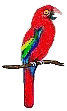
His name is Papagai, the Provençal word for parrot.
The name shares its roots with the Old French papegeai, the German Papagei, the Portuguese papagaio, and the Italian pappagallo. As the Lexilogos mascot, Papagai reminds us that mimicking and repeating is often the best way to master new words and store them in the "hard drive" of our brain—whose memory is, alas, all too limited.
Lexilogos is anchored in a calanque—a narrow, steep-walled limestone inlet—in Provence, Southern France. The site is managed from Marseille, a city founded by Phocaean Greeks in the 6th century BCE and originally named Μασσαλία (Massalia).
Lexilogos was officially launched on December 3, 2002—which I like to call Saint Papagai's Day!
Beyond technical tools and a wide range of diverse resources, Lexilogos is built upon a deeply humanist foundation. My goal is to encourage the discovery of words as the most natural gateway to understanding the world's languages and cultures.
By exploring the origins of a single word, we often uncover unexpected linguistic kinships between languages that seem worlds apart. Comparing the history and shifting meanings of a word across different borders allows us to better understand those of our own language.
Words are more than just sounds and letters; they are a gateway to objects, concepts, traditions, and the history of civilizations. This journey from the word to the language is an invitation to discover the wonders of our world—past and present, near and far—without the tedium of formal study. It is a path where curiosity leads to understanding.
This commitment is why I have chosen to display the translation of the first article of the Universal Declaration of Human Rights on every page of Lexilogos:
"All human beings are born free and equal in dignity and rights. They are endowed with reason and conscience and should act towards one another in a spirit of brotherhood."
In a digital world that can sometimes feel fragmented, Lexilogos strives to promote this "Spirit of Brotherhood" through the simple, yet profound, act of sharing the world's languages through the discovery of words.
Lexilogos is an ongoing project that grows through the curiosity and contributions of its users.
Share your discoveries: If you know of any high-quality resources or interesting websites that deserve to be featured on Lexilogos, your suggestions are highly appreciated.
Report issues: To ensure the best experience for everyone, please report any malfunctions, such as broken links or errors.
Get in touch: To send an email, simply click on the envelope icon at the bottom of each page.
Help keep Lexilogos free and independent by making a donation!
My passion for words is inseparable from a lifelong interest in origins. For me, Etymology and Genealogy are two fields that spark a shared curiosity: they allow for the discovery of both words and people, offering a unique gateway into history from different perspectives.
In exploring my own family's journey, I also find a deeper connection to the history of Protestantism and its heritage. You are welcome to explore these personal roots:
The history and meaning of my first name Xavier (of Basque origin from Navarre)
The origins of my surname Nègre (of Occitan origin from the Cévennes)